UV Resistance of Cables and Mounting Hardware: An Underestimated Factor in PV Systems
Why the choice of materials determines safety and service life
In photovoltaic systems, cable ties and protective conduits are constantly exposed to the elements. The selection of these seemingly minor components significantly influences how long a system can operate safely and without malfunctions.
In addition to UV radiation, other environmental factors affect the material: temperature fluctuations, humidity, and salt content take a toll on plastics and metals over the years. A special label helps with targeted product selection.
The selection is particularly critical in industrial areas and coastal regions, where pollutants and salt exposure additionally affect the components. For ground-mounted solar systems, making an informed material decision is therefore a central part of project planning.
Cable ties: appropriate material class depending on location
Standard black cable ties offer UV resistance for only about three years. They are therefore unsuitable for long-term use in photovoltaic systems, even though they are frequently installed in practice.
The following overview shows which material is recommended depending on the climate zone:
| Cable tie types | UV resistance | Recommended climate zone |
|---|---|---|
| Black cable ties, polyamide 6.6 | approx. 3 years | Not suitable for permanent outdoor PV installation |
| UV-stabilized PA 6.6 cable ties | 10–15 years ( , HPER® –15 years) |
Central Europe, Mediterranean region |
|
Polyamide 11 cable ties |
Very good UV resistance
|
Subtropical or alpine locations
|
| Stainless steel | > 40 years | Subtropical or alpine locations, industrial/coastal |
If no special environmental requirements are expected, these material standards can be used as a guide for selection.
Nevertheless, in practice, standard cable ties with only three years of UV resistance are frequently used. It is therefore recommended to specifically request the technical data sheets from the supplier and, in particular, to carefully review the information regarding UV resistance. This review is an essential part of any sound procurement decision in the PV sector.
Cable ties as part of a comprehensive cable management system
Cable ties are always a component of a well-thought-out and comprehensive cable management system. Many installation errors can be avoided simply by using the right combination of components.
A typical example: Even high-quality cable ties should never be routed directly through a laser-cut mounting hole in the module frame. Suitable edge clips protect against material damage and improper stress and are therefore an integral part of proper cable routing.
Preventing contact corrosion on aluminum profiles
When mounting edge clips and other fasteners on the aluminum profiles of solar modules, UV resistance is not the only factor that matters. Protection against contact corrosion is equally essential.
Contact corrosion occurs when different metals are combined, such as steel clips and aluminum frames. Moisture further exacerbates the process. As a result, the aluminum is corroded, leading to material damage and sharp edges that can damage or destroy the cable insulation.
High-quality clips with special coatings that prevent direct metal contact provide a solution. A reference in the data sheet to a zinc-aluminum double coating is a good indicator of long-term reliability.
Cable protection conduits: Selection criteria for above-ground and underground installation
When selecting protective conduits, at least four properties should be considered: UV resistance, fire resistance, mechanical strength, and watertightness. Which conduit is suitable depends primarily on the installation method.
Above-ground installation
For above-ground installation, long-term UV-resistant corrugated pipes made of PP plastic are ideal. They are lightweight, flexible, and resistant to UV light for up to 20 years. They are available in slotted, unslotted, and two-piece versions—to suit the specific installation situation.
Underground installation in open-space systems
For underground installation in open-space systems, rigid or flexible pipes made of HDPE plastic are the best choice. UV-resistant special designs also enable universal hybrid solutions for mixed installation routes.
A common mistake: Unsuitable in-ground pipes, such as black FBY pipe without UV resistance, are frequently installed. This poses a high risk to the cables in the system. Here, too, it is essential to carefully review the technical data sheets in advance.
The UV-Stabil Label as a Guide
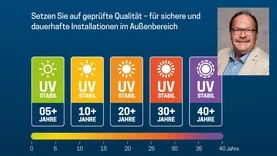
To simplify the selection process, EMC-direct’s UV-Stabil label exclusively designates components with proven long-term UV stability. It offers planners, architects, and installers clear guidance when selecting products.
Each label transparently indicates the number of years for which UV protection is guaranteed. Additional color coding enables quick product identification and thus supports efficient, safe project planning.
Frequently Asked Questions (FAQ)
How long are standard cable ties UV-resistant?
Standard black cable ties have a UV resistance of only about three years and are unsuitable for continuous use in photovoltaic systems.
Which cable ties are suitable for PV systems in Central Europe?
Cable ties made of UV-stabilized polyamide 6.6 are recommended, such as HPER cable ties with a tested UV resistance of 15 years. For subtropical or alpine locations, polyamide 11, 12, or stainless steel with a service life of over 40 years are recommended.
What is contact corrosion and how can it be prevented?
Contact corrosion occurs when different metals, such as steel clips and aluminum frames, come into contact with each other, especially in the presence of moisture. Clips with coatings, such as a zinc-aluminum double coating, prevent direct metal contact.
Which protective pipes are suitable for above-ground and underground installation?
For above-ground installation, long-term UV-resistant PP corrugated pipes (UV-resistant for up to 20 years) are suitable; for underground installation, rigid or flexible HDPE pipes are recommended. Unsuitable concealed pipes, such as black FBY pipe, should be avoided.
What should you look for when selecting a product?
Pay attention to the technical data sheets, particularly the information on UV resistance. Markings such as the UV-Stabil label make it easier to select tested components.
Those who wish to delve deeper into the quality requirements for the assembly and electrical installation of PV systems will find practical guidance in the white paper “Understanding—and Avoiding—Common Causes of Damage to Photovoltaic Systems” by EMC-direct.
Download the white paper for freeSource & further information:
Source: https://www.photovoltaik.eu/wartung/emc-direct-uv-bestaendigkeit-von-kabeln-nicht-unterschaetzen
The author: Frank Mazur is Sales Manager at EMC-direct and an expert in cable management and cable protection for PV systems. The company, based in Dorsten near Gelsenkirchen, specializes in cable protection and mounting technology and supplies major solar projects in Austria and Denmark, among others.