
Armored conduit in electrical installations: classification and modern cable protection systems
The term armored conduit is used in practice for cable conduits with increased mechanical load-bearing capacity. There is no standardized definition. The term is used inconsistently on the market and describes a certain level of protection for cables and conduits rather than a specific product. The requirements of DIN EN 61386 (VDE 0605), which classifies conduit systems in terms of mechanical, thermal and other properties, are technically relevant.
Historically, armored conduit was primarily understood to mean rigid metal conduits (e.g. steel conduits). Today, the term is used much more broadly and also includes plastic pipes and flexible corrugated pipes, provided they have a corresponding mechanical load-bearing capacity.
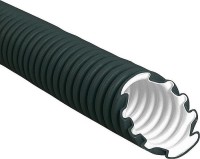 Corrugated pipe FBY Sliding layer unslotted
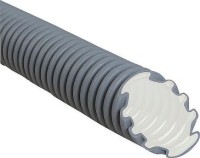 Corrugated pipe FFKUS with sliding layer unslotted
 Corrugated pipe PP - 750N halogen free
 Corrugated pipe PVC - 750N unslotted
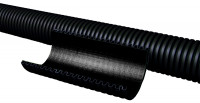 Corrugated pipe HDPE smooth inside - draw-in aid
Conceptual classification
"Armored pipe" is not a defined product type, but a colloquial collective term. Depending on the context, it can refer to different systems:
- rigid metal pipes (classic: high mechanical load capacity)
- rigid plastic installation pipes (often used in building installations)
- flexible corrugated conduits for flush-mounted installations (e.g. FBY types)
- flexible corrugated conduits with increased mechanical load-bearing capacity (for industry, mechanical engineering or photovoltaics)
The decisive factor is always the properties according to DIN EN 61386, not the designation. The mechanical classification, the material used and the specific application are decisive for the selection.
Requirements according to DIN EN 61386
The standard classifies pipe systems into standardized classes based on defined properties, among other things:
- Compressive strength: Describes the load-bearing capacity without unacceptable deformation (important for concealed, concrete or underground installation).
- Impact resistance: Protection against mechanical impact.
- Temperature resistance: Defines the permissible temperature range.
- Flexural strength & fire behavior: Other important criteria for safety and installability.
- Bendability / flexibility: Classifies whether the pipe is rigid, pliable or flexible (decisive for ease of installation).
- Protection class (IP): Determines the degree of protection against the ingress of solids and water (important for system tightness).
- Corrosion behavior: Defines the resistance to chemical influences and corrosion (particularly relevant in outdoor areas).
- Fire behavior: Classifies the resistance to flame propagation (e.g. flame retardant).
- Electrical properties: Describes characteristics such as the electrical insulating capacity or electrical conductivity of the system.
Do you need large purchase quantities?
Then contact our sales team directly!
Free advice: +49 2369 9846915
The clear distinction: rigid pipe vs. modern corrugated pipe
In modern practice, the distinction is crucial. Rigid armored conduit is dimensionally stable and suitable for straight cable runs. However, it is inflexible and difficult to work with. Every bend requires complex bending (for metal) or suitable fittings such as angle pieces (for PVC). This increases the assembly effort, costs time and increases the error rate during assembly.
EMC-direct's portfolio therefore focuses on heavy-duty corrugated conduit. These flexible armored corrugated pipes adapt dynamically to the installation path and generally do not require any additional bends. This leads to a noticeable reduction in installation time and the number of components required in the warehouse. The corrugated pipe can be an economical alternative in many applications.
Load types in practice
The dominant load type is decisive for the selection:
Static load
e.g. flush-mounted, concrete, soil: The compressive strength is primarily decisive here.
Dynamic load
e.g. mechanical engineering, robotics: Flexibility, impact strength and fatigue strength are important here.
Material advantages: Why corrugated pipes made of high-performance plastics are superior
The performance of our corrugated armored conduits is based on high-tech plastics. The choice of material has a decisive influence on the properties:
- Polyamide (PA): Materials such as polyamide 6 or 12 are extremely impact-resistant, have high toughness and a wide temperature range. Unlike metal pipes, they cannot corrode. This is a huge advantage, especially in aggressive industrial environments.
- Polypropylene (PP): Offers good chemical resistance and solid mechanical properties.
- PVC: Economical and easy to process, often used for flush-mounted applications in building installations.
- HDPE: Highly resistant to moisture and chemicals, ideal for underground installation.
Safety and fire protection
The issue of safety also speaks in favor of corrugated pipe. Many of our systems are available halogen-free. In the event of fire, no toxic or corrosive gases (acid formation) are produced with these variants. This protects people and prevents consequential damage to electronics. Rigid PVC pipes often cannot offer this specific protection. Halogen-free pipes are now standard in buildings with high fire protection requirements.
Mechanical protection values according to DIN EN 61386-1
Despite their flexibility, our corrugated conduits are extremely resilient. Depending on the design, they achieve high classifications for compressive strength and impact resistance (e.g. up to 1250 N or 4000 N compressive strength).
Concrete and underground installation
Specially approved types are suitable for installation in concrete or in the ground. However, the specific requirements for the pressure class, temperature and the pipe types approved for the respective type of installation must always be observed.
Dynamic applications
A corrugated armored conduit shines particularly well in robotics or moving machine parts. Where rigid pipes are not designed for dynamic loads due to their construction, special corrugated pipe types remain permanently elastic over millions of bending cycles. It reliably protects the cables from material fatigue and expensive failures.
Comparison: Classic armored tube vs. EMC corrugated tube system
| Characteristic | Rigid armored tube (steel) | EMC corrugated armored conduit (flexible) |
|---|---|---|
| Installation | Time-consuming (bending/threading) | Very fast (flexible) |
| Corrosion | Risk of damage | Absolutely rustproof |
| Weight | Very high | Very low |
| Retrofitting | Complex | Simple (due to separable pipes) |
Use in photovoltaics: robustness meets flexibility
Protection against UV radiation and rodent bites is crucial for PV systems. Corrugated conduits specially developed for outdoor use are UV-stable and weather-resistant for decades. Rigid pipes expand differently in heat than the cables inside. This can lead to mechanical stresses. Our flexible armored corrugated conduits compensate for these movements effortlessly. The mechanical protection of the cable insulation preserves the integrity of the system and significantly reduces the risk of insulation faults (which can lead to earth faults).
Efficiency through intelligent systems
Looking at the total cost of ownership, flexible corrugated pipe systems can offer economic advantages. The quick and easy installation and the reduced need for fittings help to reduce installation times and therefore project costs. Maintenance and retrofitting work can also often be carried out more efficiently.
Separable corrugated pipes are a particular advantage. They make it possible to retrofit mechanical protection to existing pipes without having to dismantle them. This is a practical advantage compared to rigid pipe systems, particularly for extensions, maintenance work or installations that are difficult to access.
Frequently asked questions about armored tubes
Does EMC-direct sell rigid armored tubes?
Is a corrugated tube as strong as a steel tube?
Why should I use corrugated pipe instead of rigid pipe?
Are corrugated pipes suitable for fire protection?
The specific fire protection properties - such as flame retardancy and classification - always depend on the product in question.
When is an armored conduit required?
Which standard applies to installation pipes?
Haben Sie Fragen?
Wir sind persönlich für Sie da – Montag bis Freitag von 7:30 bis 16:30 Uhr.
Alternativ nutzen Sie gerne unser Anfrageformular.