PA12 and stainless steel: materials for durable photovoltaic installations
The service life of a photovoltaic system depends not only on the quality of the solar modules, but also to a large extent on the fastening and connection materials used. Plastic parts made of PA12 and stainless steel components have proven to be particularly reliable in practice, as they combine UV stability, corrosion protection and mechanical stability. When planning and installing professional PV systems, these material properties should be taken into account at an early stage to ensure long-term operational reliability.
Polyamide 12 (PA12): The specialized plastic for the solar industry
In photovoltaic installation, it is often wrongly assumed that UV-stabilized PA6.6 is sufficient for all outdoor applications. However, practice shows that UV radiation is only one of many stress factors. Polyamide 12 (PA12) has established itself as a technically superior solution, as it eliminates specific weak points of standard plastics.
Molecular advantages and low water absorption
Hygroscopicity is a critical factor for the durability of plastics. PA12 has a modified molecular structure with extremely low water absorption. This means that the material remains impact-resistant and flexible without becoming brittle, even in extremely dry conditions or long periods of frost.
Resistance to zinc chloride and galvanic corrosion
An often underestimated risk when using standard cable ties is chemical incompatibility with the mounting systems. Many substructures are made of galvanized steel. In combination with moisture, salts or chloride-containing air pollutants, zinc chloride can form. PA12 is one of the few high-quality plastics with complete zinc chloride resistance.
Stainless steel fasteners: Maximum safety for extreme environments
In photovoltaic installations, there are scenarios in which even high-performance plastics such as PA12 reach their physical limits. Wherever extreme mechanical loads, aggressive atmospheric conditions or strict fire protection requirements prevail, stainless steel fasteners are the technical spearhead.
Corrosion protection near the coast and offshore installations
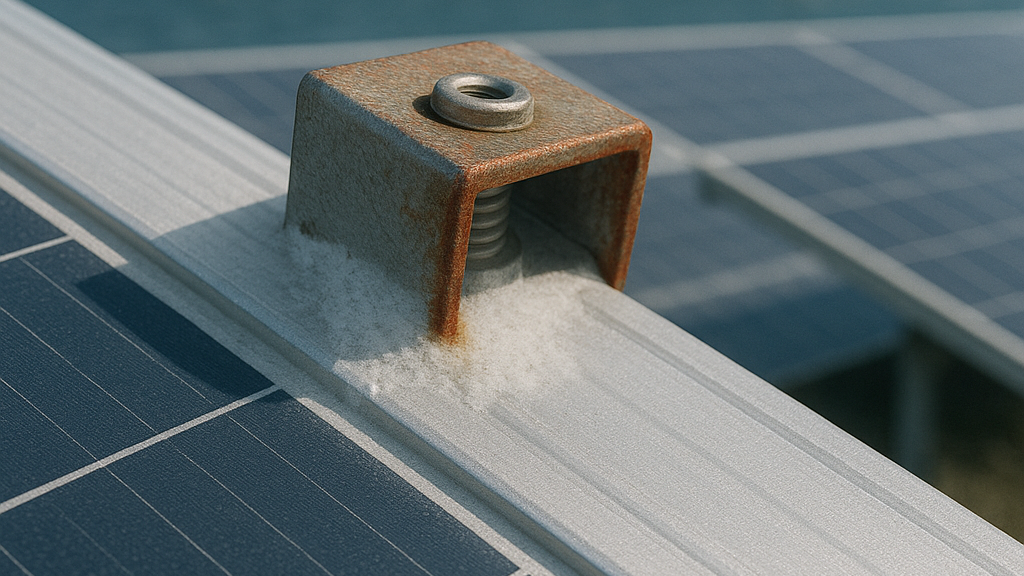
Installations in maritime environments are permanently exposed to salt. This chloride-containing atmosphere drastically accelerates corrosion processes. While conventional steels fail here within a short time, stainless steels of the V2A (304) or V4A (316) grades offer long-lasting protection.
Fire protection and mechanical limit loads
Stainless steel fasteners are non-combustible and do not contribute to the spread of fire in the event of a thermal incident. They also have superior tensile strength - ideal for extreme wind loads or large cable cross-sections with a high dead weight.
Material comparison: PA12 vs. stainless steel
| Criterion | PA12 (high-performance) | Stainless steel (V2A/V4A) |
| UV stability | Very high (solar-specific) | Excellent |
| Water absorption | Very low (approx. 0.8 %) | Zero |
| Zinc chloride resistance | Fully immune | Fully immune |
| Service life (outdoor) | Approx. 25 years | Over 30 years |
| Fire protection (UL 94) | V2 / HB | Non-flammable |
Advantages of combining PA12 and stainless steel
The combination of both materials creates synergies for fastening solar modules:
- Clamping systems: PA12 clamps with stainless steel screws ensure a tight fit with simultaneous flexibility.
- Load distribution: Stainless steel brackets carry the mechanical load, while PA12 clips dampen vibrations.
- Corrosion-free: Material separation minimizes the risk of galvanic corrosion.
- Efficiency: PA12 components can often be mounted on stainless steel brackets without tools.
Components alone are not enough - interaction is crucial
A durable system can only be created if the components are used correctly:
- Combine PA12 ties with PA12 or coated stainless steel clips.
- If necessary, use stainless steel ties with insulating underlays.
- Do not install uncoated metal clips directly on aluminum profiles.
- Always apply edge protection to all sharp edges.
Operational safety starts with planning
- Determine corrosivity class - in accordance with ISO 9223 (C1-CX).
- Define material guidelines: PA12 for C3-C5; stainless steel for C5-CX.
- System check: Check chemical compatibility between the binder and the mounting rail.
- Installation quality: Observe preload and ensure water drainage.
Conclusion: Durable fastening for PV modules
The combination of PA12 and stainless steel combines mechanical stability with long-lasting weather resistance. Choosing these materials reduces maintenance costs and secures the return on investment for decades.
Frequently asked questions about PA12 and stainless steel
When is stainless steel essential for cable fastening?
In corrosive environments such as near the coast or in agriculture, as well as in strict fire protection regulations that require non-combustible materials.
Can PA12 clamps be used for all module types?
Yes, they are available in different versions and are particularly gentle on bifacial and standard glass-glass modules.
Do PA12 clamps require regular maintenance?
They are largely maintenance-free. However, a visual inspection as part of normal system maintenance is recommended.
Managing Director of EMC-direct
As Managing Director, Thaddäus Nagy is responsible for the strategic direction and product management at EMC-direct. With his many years of experience in photovoltaics and connection technology, he ensures that installers always have access to innovative, high-quality solutions. His focus is on the development of practical products for maximum safety and efficiency.

Free white paper on the safe operation of systems
EMC-direct's specialist authors have created the white paper "Knowing - and avoiding - common causes of damage to photovoltaic systems" to raise awareness of quality standards.
Source & further information: www.photovoltaik.eu