
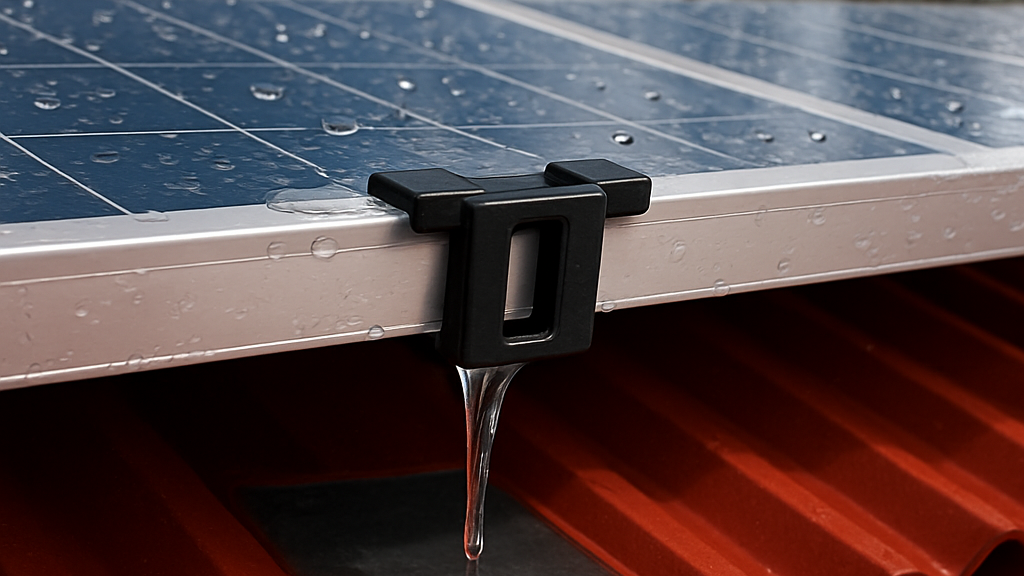
Drainage clips against soiling: increased yield through optimized module drainage
Soiling can significantly impair the performance of your PV system. Even slight soiling leads to a loss of efficiency and can reduce the service life of the modules. Drainage clips offer a practical solution here: they improve water drainage, prevent the accumulation of dirt and support the self-cleaning of the modules. With this measure, yield losses can be minimized and maintenance and cleaning costs can be sustainably reduced.
What is soiling and why is it relevant?
Soiling describes the deposition of dirt particles on the surface of solar modules. This soiling acts as a barrier to sunlight and can reduce the yield of a PV system by 3 to 5 % per year. In addition to efficiency losses, they increase the risk of hotspots. Drainage clips specifically address this problem by reducing the accumulation of dirt on the module frame and improving self-cleaning by rainwater.
How drainage clips work
Drainage clips are small but effective aids that are attached along the edges of the module. They drain rainwater efficiently over the edge of the frame, prevent the formation of waterlogging and thus reduce the accumulation of dirt particles.
Important properties:
- Self-cleaning effect: dirt is automatically removed when it rains.
- Simple installation: Can be retrofitted without special tools, compatible with standard frame profiles.
- UV resistance: Made of UV-stabilized plastic for a long service life.
Advantages of drainage clips at a glance
- Reduction of soiling: Less dirt deposits lead to more stable yields.
- Minimized maintenance: Longer intervals between cleaning save costs.
- Prevention of waterlogging: No water accumulation at the lower module edges.
- High cost-effectiveness: Low investment costs are often amortized with just one cleaning.
Installation and application instructions
According to the recommendations of the IEA PVPS, the inclination of PV modules should be at least 10° to allow water to drain off. Drainage clips are a decisive support, especially for flat installations (e.g. on carports or flat industrial roofs).
The clips cannot work on a slope of exactly 0° (completely flat installation) as there is no gradient for water drainage. In addition, clips do not replace basic cleaning in the event of extreme incrustation, but merely increase the intervals between cleaning.
Conclusion: More yield through simple solutions
Soiling is one of the underestimated factors influencing the profitability of PV systems. Drainage clips offer a simple way to support the natural self-cleaning effect. The result is more stable yields and a more even load on the modules.
Frequently asked questions about drainage clips
When is it particularly worthwhile using them?
Particularly for flat pitched systems (< 15°) in dusty or pollen-rich environments (e.g. agriculture), where typical dirt marks form on the lower module frame.
Can the clips be retrofitted?
Yes, the clips are designed for easy retrofitting. They are attached to the existing module frame without tools.
Which module types are they suitable for?
They are compatible with almost all framed standard modules. Due to their design, they are not suitable for frameless glass-glass modules.
Managing Director of EMC-direct
Thaddäus Nagy is responsible for strategic development at EMC-direct in the field of connection technology. With his many years of experience in the photovoltaic industry, he focuses on practical solutions for yield optimization and operational reliability of solar systems.

Free white paper on the safe operation of photovoltaic systems
Experts from EMC-direct have developed the white paper "Knowing - and avoiding - common causes of damage to photovoltaic systems" to raise awareness of the highest quality standards.
Source & further information: www.photovoltaik.eu