
- 1. Why cable protection in PV systems is often underestimated
- 2. UV resistance: materials, additives, proofs
- 3. Separate areas of application: Roof/exterior, ground, concrete
- 4. Pressure requirements in the ground (tips)
- 5. Animal browsing in PV parks: Measures with a sense of proportion
- 6. Procurement & verification (DE/EU)
- 7. Selection tips & product examples
- 8. Conclusion: System quality through suitable pipe selection
Why cable protection in PV systems is often underestimated
Photovoltaic systems do not only consist of modules, cables and inverters. Clamps, clips and, in particular, conduits also influence service life and operational safety. Unsuitable standard empty conduits on roofs quickly become brittle due to UV radiation - with risks for cable sheaths, seals and yield.
UV resistance: materials, additives, verification
Black coloration is not proof of UV resistance. UV radiation gradually degrades polymers; without stabilization, plastics lose toughness and can crack. Long-term UV-stabilized types are mandatory for outdoor and roof mounting. Proven in the PV environment: PP-UV, HDPE-UV and - in UV-stabilized versions - PVC-U with coordinated additive packages. Tested compounds and reliable evidence (e.g. e.g. tests in accordance with ISO 4892-2) are essential. Standard PVC installation pipes without UV certification (e.g. e.g. FBY, FFKuS) are not suitable for outdoor and roof applications.
Separate areas of application: Roof/exterior, soil, concrete
- Roof & exterior sections: Only use long-term UV-stabilized pipes (PP-UV, HDPE-UV or PVC-U in UV-resistant design with verification). Avoid standard installation/concealed/concealed empty pipes (incl. standard corrugated PVC installation pipes such as FBY/FFKuS and a.) outdoors.
- Soil: Design the compressive strength for the load case. High compressive strengths are often required for large solar parks(guide value: > 750 N). Refer to the manufacturer's data sheets for specific classes.
- Concrete/over-concreting: Only use pipes that are expressly designated as suitable for concrete. Lightweight soil pipes are typically not approved for this purpose.
- Fire protection/halogen-free: Provide halogen-free, flame-retardant types in safety-relevant areas; consider conflicting objectives (impact resistance/costs).
Pressure requirements in the ground (notes)
The required compressive strength depends on the type of installation, compaction, traffic and point loads. Standard and class assignment as well as permissible installation types must be checked in the data sheet depending on the manufacturer.
Animal browsing in PV parks: measures with a sense of proportion
"Marten-proof" means risk reduction, not absolute protection. Chemically neutral, low-taste plastics (e.g. e.g. PA, PP) and smooth, hard surfaces, to which marking odors adhere less well, are tried and tested. Special additives/formulations can provide support in outdoor areas. In hotspots, metal-coated or hybrid-reinforced systems increase resistance.
Procurement & verification (DE/EU)
- Do not install standard installation/flush-mounted pipes on roofs.
- Request UV test reports (e.g. e.g. ISO 4892-2), pressure resistance, temperature range and fire information if necessary.
- IP protection depends on the connection system (sleeves/couplings, sealing compounds) - check data sheet.
- Relevant installation standards and project specifications apply for underground installation; specific standard assignment is made via the product data sheet.
Selection information & product examples
- HDPE-UV (unslotted, with tension wire) - for buried PV/RES applications; concrete cover only with express approval. Link: HDPE corrugated pipe (UV, 10 years)
- PP-UV corrugated pipe (long-term UV-resistant) - for outdoor/roof routes; verify pressure/temperature/bending radius and fastening systems on a project-specific basis. Link: PP corrugated pipe (UV)
- Compound solutions - combine UV stabilization, compressive strength and, if necessary, fire protection; selection strictly according to project specification and data sheet.
Conclusion: System quality through suitable pipe selection
UV-resistant protective conduits are central to PV cable protection. Those who clearly separate areas of application (roof/outside vs. underground), select PP-UV, HDPE-UV or PVC-U in UV-stabilized design, take into account high pressure requirements in the ground(guideline value: > 750 N) and demand reliable proof (UV tests, IP protection according to data sheet), reduce failures and rework and increase system availability.
Managing Director EMC-direct
Thaddäus Nagy is responsible for cable protection for PV and wind energy projects at EMC-direct. He supports ground-mounted systems in the MW range throughout Europe and has many years of experience in the plastics industry (including , BASF, Covestro, LANXESS) and in strategy consulting (BCG).
"Z-parts such as protective tubes also significantly determine the service life of a PV installation. Black is not UV proof - the tested material formulation is decisive."
Further information about Thaddäus Nagy
Frequently asked questions
Is the black color sufficient as UV proof?
No. UV resistance results from additives and tested compounds - not from the color. Black alone is not proof. Test reports are decisive, e.g. e.g. in accordance with ISO 4892-2.
Which materials are suitable for roofs and outdoor sections?
PP-UV, HDPE-UV and PVC-U in UV-stabilized design with documented test certificate. Standard empty pipes without UV certification (e.g. e.g. FBY, FFKuS) are not suitable for outdoor and roof applications.
What compressive strength do I need for underground installation in solar parks?
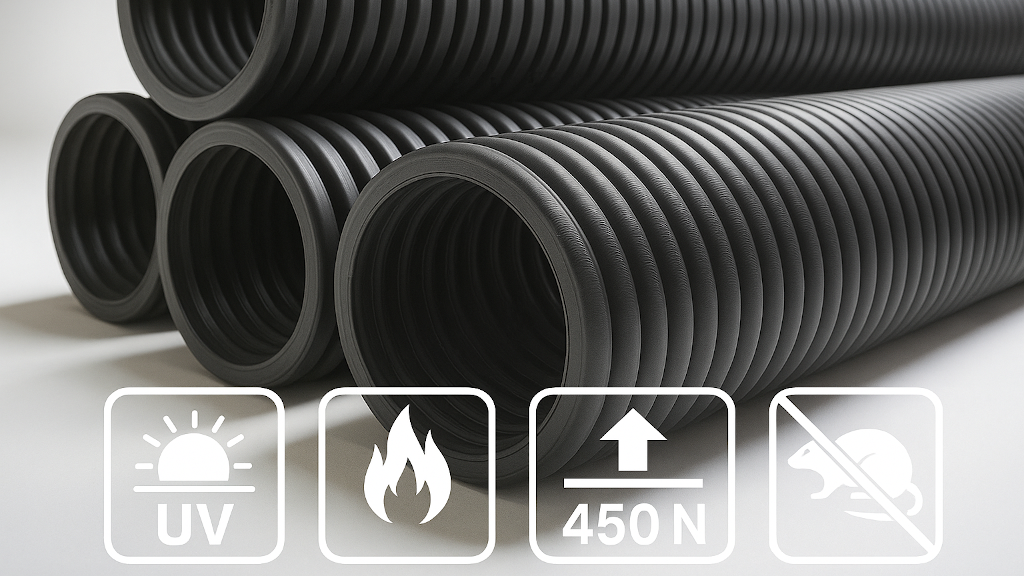
The pressure class according to EN 61386-24 is decisive for underground installation in ground-mounted solar parks. With standard-compliant bedding (sand/gravel, without driving over), 450 N is the established standard class - as designed and classified by independent manufacturers for ground-mounted PV systems. In the case of increased mechanical stress - for example due to compaction equipment, construction site traffic or shallow cover depths - 750 N or more is required. The binding specification is made depending on the load case via the product data sheet and the project specification.
What is the difference between 450 N and higher pressure classes?
450 N covers the typical ground installation case in ground-mounted PV systems with standard-compliant bedding. 750 N is used for increased loads - e.g. e.g. heavy traffic, intensive compaction, narrow cover or special soil conditions. Explicit manufacturer approval is always required for concrete coverings. The basis is EN 61386-24.
How do I take fire protection into account?
Provide halogen-free, flame-retardant types in safety-relevant areas. Observe conflicting objectives: Such pipes are flame-retardant, but can be less impact-resistant and more expensive. Implement the requirements from the project specification.
What needs to be considered for connectors and IP protection?
The IP protection of the overall system depends on the connector system used (sleeves, couplings, sealing compounds). Example: HDPE-UV 450 N achieves IP40 in its basic state; with sealing ring (up to 110 mm) IP67, with special sealing compound IP68. Please refer to the relevant product data sheet for details.
Is PVC-U approved for roof applications?
Yes - but only in UV-stabilized versions with documented test certificates. Standard PVC installation pipes without UV certification (e.g. B. FBY, FFKuS) are not suitable for outdoor and roof applications and must not be used there.
Which certificates should I request when purchasing?
UV test report (e.g. e.g. ISO 4892-2), pressure class in accordance with EN 61386-24, permissible temperature range, IP protection class of the connector system and fire protection classification if applicable. For underground installation additionally: installation approval of the manufacturer for the respective load case.
Source & further information: This article is based on the technical article by Thaddäus Nagy, published on 29.10.2025 on photovoltaik.eu: "EMC-direct: Thermowells often underestimated"