
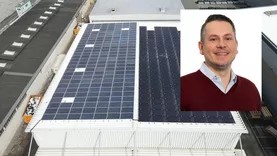
Fire protection for photovoltaic systems: understanding causes, minimizing risks in a targeted manner
Statistically, fires in solar installations are considered a rare occurrence, but when they do occur, the consequences for installation operators and the surrounding area can be serious. For planners, EPCs and technical purchasers in the field of ground-mounted photovoltaics, it is therefore essential to know the typical causes of damage and to take countermeasures during the planning and procurement phase.
How often do photovoltaic systems really burn?
The data situation is reassuring, but no reason for carelessness: according to evaluations by Fraunhofer ISE, only 0.006 percent of all installed photovoltaic systems cause major fire damage. Nevertheless, a joint analysis by Fraunhofer ISE and TÜV Rheinland shows that the causes of these incidents are clearly identifiable and therefore preventable.
The causes of damage are distributed almost equally across three areas: One third of fires are caused by defective components, a further third by planning errors, and the remaining third by errors during assembly and electrical installation. This means that planning errors and installation faults together account for around two thirds of the causes - factors that can be directly addressed through careful preparation.
Contact points are the most common weak point
Among the technical risk factors, faulty or prematurely aged electrical contacts are in first place. Particularly affected are the junction boxes of the solar modules, the connectors between modules and strings as well as terminations in distribution boxes and inverters. During operation, these weak points can lead to overheating, scorching or arcing, with potentially fire-hazardous consequences.
Short circuits: Origin and contributing factors
Short circuits are one of the most common causes of electrical fires in PV systems. They occur when two electrical conductors make uncontrolled contact with each other - the resulting current flow exceeds the permissible load and generates heat which, in the worst case, triggers a fire.
Typical triggers for short circuits in practice
- Defective insulation: Extreme weather conditions, mechanical wear and tear or manufacturing defects can damage the insulation of DC cables over time. The quality of the cable protection is a decisive factor, especially for ground-mounted systems with long cable runs and variable ambient conditions.
- Damaged or loose connections: Loose or incorrectly made connections significantly increase the contact resistance and therefore the potential for heat generation. All connections must be permanently tight, mechanically secured and protected against moisture.
- Cable damage due to animal bites: Cables can be damaged by rodents or martens during installation or operation.
Electrical arcs: an underestimated fire hazard
In addition to short circuits, electric arcs are an often underestimated cause of fire. They can occur when circuits are interrupted or become unstable. Electric arcs generate high local temperatures that are capable of triggering fires.
Common causes are loose electrical connections, inferior or defective electrical components and advanced corrosion at contact points. The latter gradually weakens the integrity of the connection - a risk that becomes particularly relevant in long-term operation if maintenance is inadequate and quality control is lacking.
Overload and system expansion as risk factors
Overload situations are not necessarily caused by acute faults, but often by systematic planning deficiencies. If additional solar modules are added to a system at a later date without adapting the electrical components accordingly, cables and protective devices can be permanently operated above their design limits.
Added to this is the failure or complete absence of suitable protective devices such as fuses and circuit breakers. These must not only be correctly dimensioned, but also regularly checked for functionality.
Factors for the failure of inverters
Inverters are assemblies subject to high thermal loads. If they are permanently operated at their maximum output, the risk of overheating increases, especially if the ambient temperature and ventilation situation have not been sufficiently taken into account.
Manufacturing quality problems with capacitors or transformers can lead to premature failure during operation. A lack of maintenance is just as critical: minor anomalies that are not consistently rectified can develop into serious system failures with fire potential.
Conclusion
The analysis of the causes of fire clearly shows that high-quality components and careful installation are not optional quality features, but safety-relevant requirements. This applies in particular to cable protection in ground-mounted systems, where cables are exposed to changing environmental influences over long distances.
The author: Thaddäus Nagy, Managing Director of EMC-direct, and his team have been involved in the construction of several dozen ground-mounted systems across Europe over the past two years. He emphasizes the importance of reliable cable protection and fastening solutions as a preventative measure against typical causes of damage. The specialist for cable protection and fastening technology from Dorsten supplies major projects in Austria and Denmark, among others.
Frequently asked questions (FAQ)
What is the statistical probability of fire in PV systems?
According to Fraunhofer ISE, only 0.006 percent of all photovoltaic systems cause major fire damage. The risk is therefore very low - but requires professional planning, high-quality components and correct installation.
Which components in PV systems are most at risk of fire?
According to an analysis by Fraunhofer ISE and TÜV Rheinland, electrical contact points such as module junction boxes, connectors and distributor connections are considered to be particularly critical. Cable insulation and inverters are also among the relevant risk areas.
How can arcing in PV systems be detected and prevented?
Arcs are usually caused by loose connections, corrosion or defective components and are difficult to detect at an early stage without regular visual inspection and functional testing. High-quality connection technology, professional installation and structured maintenance intervals have a preventive effect.
What role does cable protection play in fire prevention in ground-mounted systems?
Unprotected or poorly insulated cables are susceptible to the effects of weather, mechanical wear and tear and animal browsing. Suitable cable protection solutions such as corrugated conduits or protective conduits can protect cables from the weather, mechanical wear and tear and animal browsing, thus preventing insulation damage.
What should EPCs and planners specifically consider in order to minimize fire risks?
The selection of standard-compliant, quality-tested components, dimensioning of all electrical components in line with the system size and a structured maintenance concept are crucial. Load scenarios, ambient conditions and possible system expansions should be taken into account at the planning stage.
EMC-direct provides the free white paper for download for an in-depth discussion of typical causes of damage to PV systems:
Download whitepaper free of chargeSource reference & further information
First publication 19.03.2025
Source: https://www.photovoltaik.eu/installation/emc-direct-brandrisiken-kennen-und-vermeiden