
Why Tool Quality Is Critical to System Safety
The operational safety and effectiveness of a photovoltaic system hinge on an often-overlooked detail: the quality of its electrical connections. In practice, this aspect rarely receives the attention it deserves. Yet reliable energy yield begins with the tools installers use to work on the solar cables.
Arnd Diedrichs, Head of Product Management at EMC-direct, explains how to recognize good crimping and wire-stripping tools. His basic principle is simple: Cutting corners on tools risks installation errors that will prove costly later on.
Stripping: The First Step in Crimping
Before a contact is crimped, the solar cables must be stripped. Both manual and automatic tools can be used for this purpose. Manual stripping pliers use blades that are precisely matched to the respective cable cross-section, thereby consistently delivering clean results.
The downside: Each cross-section requires the right tool, which increases the effort involved. Automatic stripping pliers, on the other hand, adjust automatically to different cross-sections, thereby speeding up installation. However, the selection of reliable automatic models is still limited at this time.
If you want to play it safe, opt for tested brand-name quality. Before making a purchase decision, it’s worth testing a tool’s function and handling yourself.
Crimping Tools: Wide Selection, Significant Quality Differences
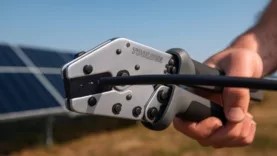
For the actual crimping process, a significantly wider range of tools is available than for stripping. The differences in quality are not always apparent at first glance. The crimp die—the mold that permanently and securely crimps the connector—is the decisive factor.
The weak points of cheaper pliers often lie in ergonomics, handling, and durability. A low-quality crimping tool gives itself away through a rickety construction, weak springs, and a noticeably light weight. Such defects lead to poor results, which impact cost-effectiveness and, under certain circumstances, the safety of the system. Robust, solidly built tools, on the other hand, deliver reliable results.
Rattle Test and Ratchet Test
Two simple tests can help with the assessment. In the rattle test, quality is evident from minimal play between the components: When you move a high-quality tool, nothing rattles. The solid construction also ensures a noticeably heavier feel in the hand.
The ratchet test provides further insight. If the tool ratchets, the sound should not resemble that of cheap plastic. Such a sound indicates thin sheet metal and inadequate material quality. Ergonomic handles without visible mold lines also show that the manufacturer takes user comfort seriously—an important criterion in daily use.
A Look Inside the Crimp Die
A key quality feature can be found in the crimp die itself. The pressing surface should not only be cleanly machined but also polished. Polished dies deform the connecting material evenly and smoothly, without material residue getting caught or the metal being pressed unevenly.
The result is smooth, uniformly shiny, and neatly rounded connections. They are a reliable indication that the tool and the workmanship are well-matched.
Common Crimping Errors and Their Consequences
Substandard tools often lead to faulty crimping. The direct consequence is increased electrical resistance in the connection. Under load, the contact point heats up, which in extreme cases can lead to burning.
Especially with the DC connectors in a PV system, the quality of the crimp is therefore a key factor in ensuring operational safety. A clean crimp is the foundation of a connection that can withstand long-term stress.
A Focus on Quality That Pays Off
The “Solar Bankability” project by Trust-PV demonstrates just how serious the consequences of installation errors can be. According to the project, faulty installation and wiring are the most common causes of faults in photovoltaic systems.
For installers and system operators alike, a consistent focus on quality thus pays off immediately. High-quality tools are therefore less a matter of convenience and more a prerequisite for permanently reliable connections.
Frequently Asked Questions (FAQ)
How can I tell if a crimping tool for solar cables is high-quality?
High-quality tools have minimal play between components (rattle test), feel heavier in the hand due to their solid construction, and feature ergonomic handles without visible flash. A polished crimp die is another key feature.
Manual or automatic wire strippers—which is better?
Manual pliers are particularly precise thanks to their cross-section-specific blades, but require the right tool for each cross-section. Automatic pliers adjust themselves and work more efficiently, but reliable models are currently only available in limited quantities.
Why is a polished crimp die important?
A polished crimping surface deforms the connection material evenly and smoothly. This prevents material residue from getting stuck and ensures the metal is not crimped unevenly. The result is smooth, cleanly rounded connections.
What are the consequences of a faulty crimp?
A faulty crimp increases the electrical resistance in the connection. Under load, the contact point heats up, which in extreme cases can lead to burning—posing risks to the system’s output and safety.
For more detailed information on safe assembly and electrical installation, download the free white paper “Understanding—and Avoiding—Common Causes of Damage to Photovoltaic Systems,” available for download from EMC-direct.
Download the free white paperSource Citation & Further Information
First published: August 27, 2025
Source: https://www.photovoltaik.eu/wartung/emc-direct-crimpen-nur-mit-hochwertigem-werkzeug
Guest Author: Arnd Diedrichs heads up product management at EMC-direct.