Cable Ties in Photovoltaics: UV-Stabilized PA6.6, PA12, or Stainless Steel?
Solar farms are designed to last 20 to 30 years. Investors, EPCs, and operators base their profitability calculations on this timeframe, and the modules and mounting structures are designed accordingly. One component often falls through the cracks until it fails: cable fasteners. The material used in a cable tie affects safety and energy yield over the entire operational lifespan—and thus the return on investment.
Why a C-part determines economic viability
Cable ties are considered small parts with a negligible unit price. This is precisely what leads to a risky oversimplification: those who focus solely on the purchase price overlook the follow-up costs over the system’s lifespan. Thaddäus Nagy, Managing Director of EMC-direct, sums up the risk: Those who focus solely on the unit price end up learning the hard way.
UV-stabilized polyamide 6.6 (PA6.6) is considered by many to be the standard solution for every application. This is not true for every location. Depending on the service life and environment, PA12 or stainless steel may be the more technically suitable choice.
What the damage data shows
The “Solar Grade PV Health Report” from Heliovolta demonstrates just how significant the impact of cable management is. The analysis is based on more than 60,000 data points. According to the report, 61 percent of the systems examined exhibit significant or critical defects. Of these defects, 91 percent are found in the DC field. Roughly one in four failures in the DC field (26 percent) is attributable to poor cable management.
Despite these figures, the industry continues to assume that UV-stabilized PA6.6 ties will last the entire lifespan of a solar farm without any problems. Reality proves otherwise.
The 20-Year Misconception About PA6.6
UV-optimized PA6.6 is frequently used in ground-mounted solar farms. Additives and a higher carbon black content slow down material degradation, but they do not alter the material’s chemical limits.
The combination of prolonged UV radiation, moisture, and extreme temperature fluctuations is particularly critical. PA6.6 absorbs a comparatively large amount of moisture. Over the years, this causes the material to become brittle and lose mechanical strength. In Central Europe, such binders are designed for a realistic service life of around 15 years. For a system intended to supply electricity for 25 years or longer, this is insufficient if one wishes to avoid costly consequential damage.
Chemical Exposure at the Site
In addition to weathering, there are often chemical influences from the surrounding environment. Salty air near the coast, fertilizers on agricultural land, or nearby chemical plants place additional stress on the polymer. Under such conditions, PA12 can demonstrate its durability. Thus, the site-specific choice of material becomes the actual deciding factor.
The Consequences of Operational Failure
Despite minimal acquisition costs, cable fasteners directly affect operational safety. If fasteners fail after ten or twelve years, several problems arise:
- Material fatigue: Clamps gradually tear. This is often not noticed until the next maintenance check—if it is noticed at all.
- Unstable cable routing: Sagging loops form, or cables flap against the substructure in the wind.
- Shading and loss of yield: Sagging cables can shade the back side of bifacial modules. The specific yield decreases.
What was supposed to be a cost-effective component thus results in avoidable replacement costs and time-consuming warranty claims. These costs quickly exceed the original purchase price many times over.
Material-appropriate selection: three performance levels
Instead of purchasing components on a one-size-fits-all basis, it is worth considering the fastening system as part of the technical engineering process. In practice, three levels have become established, tailored to service life and location.
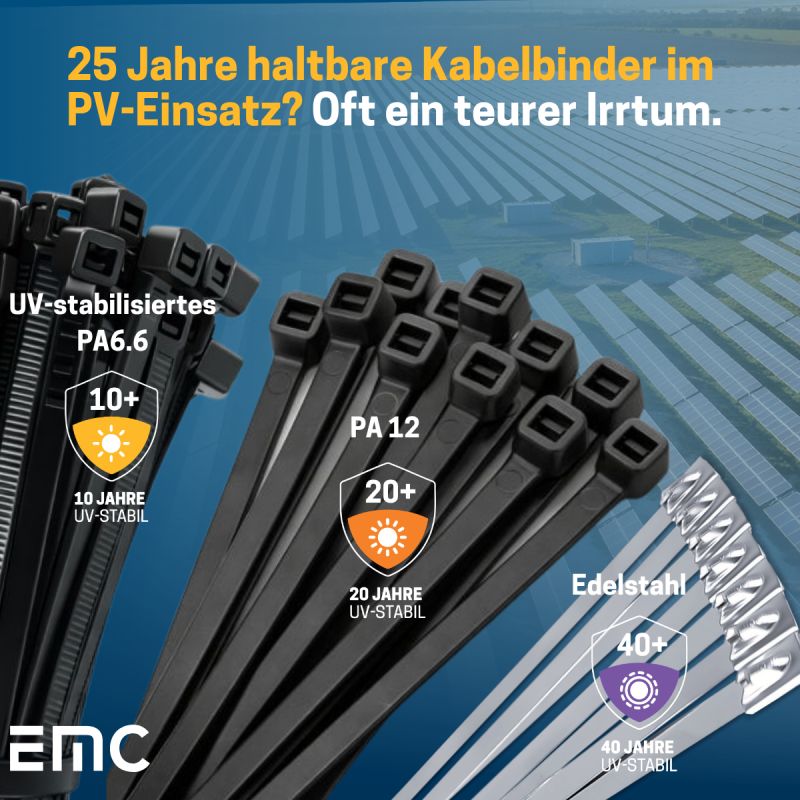
Up to about 15 years: UV-stabilized PA6.6
For rooftop systems with shorter inspection cycles, UV-optimized PA6.6 (such as HPER UV) is a robust and cost-effective solution. It achieves a significantly longer service life than standard PA6.6, but reaches its limits in true long-term projects.
20 years and more: PA12
For large ground-mounted systems, agri-PV, or locations near the coast, polyamide 12 (PA12) is the superior material. PA12 absorbs virtually no moisture and is highly resistant to UV radiation and chemicals. This ensures that its mechanical stability is maintained even after two decades of exposure to harsh outdoor conditions.
40 years and more: Stainless steel
For the highest mechanical loads, stainless steel cable ties are the right choice. Unlike polymers, they do not degrade due to UV exposure and ensure strain relief for connectors as well as cable routing close to the frame throughout the entire service life of the substructure.
Cable Management Is Part of Engineering
Professional cable management begins before installation: with a precise assessment of site conditions and the planned service life. Only then is a decision made regarding materials and the fastening concept. Materials such as PA12 provide the process reliability needed to avoid costly surprises after the first decade.
For EPCs, this means: coordinated engineering across the entire lifecycle instead of improvisation on the construction site. What matters is not the lowest unit price, but the solution that lasts as long as the facility itself.
Frequently Asked Questions (FAQ)
Which cable tie material is suitable for ground-mounted systems with a service life of 20 years or more?
PA12. It absorbs virtually no moisture and is highly resistant to UV radiation and chemicals. As a result, it remains mechanically stable even after two decades of exposure to harsh outdoor conditions.
Why isn’t UV-stabilized PA6.6 suitable for every system?
PA6.6 absorbs a relatively large amount of moisture and becomes brittle over the years due to UV exposure, moisture, and temperature fluctuations. In Central Europe, its realistic service life is around 15 years. For systems with a 25-year operating life, that is not long enough.
When is stainless steel the right choice?
For the highest mechanical loads and very long operating times. Stainless steel does not age due to UV exposure and ensures strain relief and cable routing throughout the entire service life of the substructure.
How does poor cable management affect yield?
Sagging or broken cables can cast shadows on the back side of bifacial modules and reduce the specific yield. According to the “Solar Grade PV Health Report,” 26 percent of DC-side failures are attributable to poor cable management.
Is it economically worthwhile to use more expensive cable ties?
Often, yes. The unit price is low compared to potential replacement and warranty claim costs.
More in-depth information on typical weak points is provided in the free white paper “Understanding—and Avoiding—Common Causes of Damage to Photovoltaic Systems,” written by expert authors for EMC-direct.
Download the free white paperSource Citation & Further Information:
First published: June 10, 2026
Source: https://www.photovoltaik.eu/wartung/emc-direct-material-der-kabelbinder-richtig-auswaehlen
About the Author
Thaddäus Nagy is the CEO of EMC-direct. Over the past few years, he and his team have overseen the implementation of dozens of large-scale projects (exceeding 100 megawatts) from Europe to Australia. He regularly publishes articles on material-specific cable management and cable protection, applying the technical material expertise he gained during his career in the plastics industry to the solar sector.