- 1. DC plug cross-mounting on PV systems
- 2. Why standards do not guarantee compatibility
- 3. MC4 connectors and pre-assembly
- 4. Fire hazard due to thermal overload
- 5. Loss of warranty and insurance risk
- 6. Personal liability of the installer
- 7. Practical advice from EMC-direct
- 8. Frequently asked questions (FAQ)
- 9. Note from the provider
- 10. Source & further information
DC plug cross-connection on PV systems: An underestimated safety risk
Article on the topic "EMC-direct: Cross installation is very risky" - first published on 24.09.2025 as a guest article by Thaddäus Nagy on www.photovoltaik.eu.
Anyone who installs photovoltaic systems will be familiar with the situation: the connectors from two different manufacturers can be mechanically joined together - and at first glance, everything seems to fit. However, this apparent compatibility is deceptive. Cross-installation, i.e. the combination of DC connectors from different manufacturers, is one of the most common installation errors in photovoltaics. Thaddäus Nagy, Managing Director of EMC-direct, explains the technical and legal consequences of this error.
Why standards alone do not guarantee compatibility
A common misunderstanding in practice: Because IEC 62852 is an international standard for DC connectors in PV systems, many installers assume that standard-compliant connectors can always be combined with each other. This is wrong. The standard defines minimum requirements for individual connectors - but not interoperability between products from different manufacturers.
In practice, this means that two connectors, each of which complies with the standard on its own, can cause considerable safety problems when combined. Differences in material composition, manufacturing tolerances and contact geometry mean that the contact surface is too small or mechanical stresses occur in the connector. The consequences are increased contact resistance, reduced electrical conductivity and an increased risk of heat generation and arcing.
MC4 connectors and the problem of pre-assembly
This issue is particularly relevant for solar modules that are supplied with pre-assembled connection cables. Many of these modules - especially those manufactured in Asia or China - are equipped with connectors that are described as "MC4-compatible", but are neither officially certified nor have tested compatibility with connectors from other brands.
This creates a dilemma for the installer: If the pre-assembled connector of the module is replaced by another or combined with a mating connector of a different brand, this technically constitutes a cross-installation - regardless of whether the connection can be closed mechanically. Adapter solutions often also lead to insufficient contact surface or mechanical stresses.
Fire hazard due to thermal overload
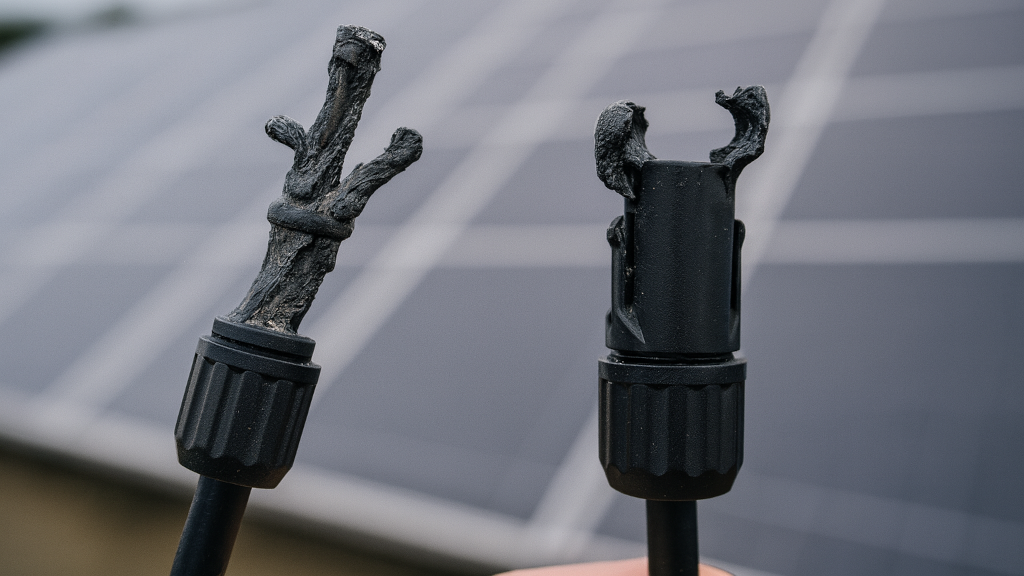
The electrical contact resistance at an improperly manufactured plug connection is not just an efficiency problem - it is a serious safety risk. High direct currents flow in PV systems for many hours every day. Even a slightly increased resistance at a plug-in point can lead to continuous heat generation, which thermally damages the connector and spreads to adjacent components.
There is also a second, insidious problem: connectors that are not designed to work together do not usually offer sufficient protection against moisture and dirt. Water - whether from rain, dew or condensation - penetrates the connection and triggers corrosion processes on the contact surfaces. These are barely visible from the outside, but increasingly impair conductivity. The consequence follows a dangerous chain of escalation: poor contact, heat development, arcing, fire.
Loss of warranty and insurance risk
The technical risks of cross-installation are serious - the legal and economic consequences are no less so. Almost all module manufacturers link their guarantee conditions to standard-compliant installation, which expressly includes the use of approved and tested plug connections. Unauthorized cross-installation can therefore be considered improper use and will result in the complete loss of the module's warranty.
In the event of a claim, many solar insurers check whether the technical connection conditions have been complied with. If cross-installation is proven, there is a risk of loss of insurance cover - even if the damage is not directly attributable to the plug connection.
Personal liability of the installer according to BGB
The civil law dimension of cross-connection is particularly important for specialist companies and independent installers. According to § 634 BGB, the contractor is liable to the customer for defects in the building. If an installation error such as cross-installation is subsequently identified as the cause of damage, the installer is liable - potentially for many years after the system has been commissioned.
What appears to be a pragmatic solution at the time of installation can therefore lead to considerable financial burdens in the long term.
Practical advice from EMC-direct
EMC-direct's advice is clear: use original connectors, use adapters certified by the manufacturer or rely on individually configured and tested connector systems from the outset.
FAQ
What is cross-mounting for DC connectors?
Cross-installation refers to the combination of connectors from different manufacturers or designs in a PV system. Even if these can be joined together mechanically, they are generally not compatible with the standards and can cause considerable safety risks.
Why are "MC4-compatible" connectors not automatically safe to combine?
The term "MC4-compatible" merely describes an external similarity with the MC4 connector system. It does not imply official certification or tested compatibility with connectors of other brands. Tolerances, materials and contact geometry can differ considerably despite similar external shapes.
Which standard regulates DC connectors in PV systems?
IEC 62852 specifies requirements for connectors for PV systems. However, it does not guarantee cross-manufacturer compatibility. For standard-compliant and safe installation, only connectors that have been approved by the module manufacturer or tested together as a compatible system should be used.
What are the legal consequences of cross-installation for the installer?
According to § 634 BGB, the installer is liable for defects in the work. If cross-installation is identified as the cause of damage, the liability can continue to apply for years after commissioning. In addition, there is a risk of loss of warranty with the module manufacturer and possible loss of insurance cover.
How can cross-installation be reliably avoided in practice?
The safest method is the consistent use of original connectors from the module manufacturer or mating connectors expressly certified by the manufacturer. Alternatively, individually configured, tested connector systems can be used. Before installation, the approval documentation for the connectors used should be checked and documented.
Managing Director of EMC-direct
Thaddäus Nagy is Managing Director of EMC-direct and is responsible for the strategic direction and international project support in the field of cable management and cable protection for photovoltaics. Together with his team, he has overseen the construction of several dozen ground-mounted systems in Europe in recent years. He supports international customers in the specification and selection of suitable components - including projects with outputs of over 100 MW. His work is based on many years of experience in plastics and plastics processing as well as an established partner, supplier and quality network in Asia.
He regularly publishes practice-oriented technical articles on cable protection and cable management in the PV environment.

Note from the supplier
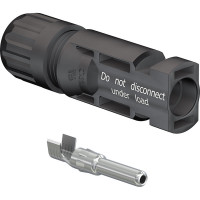
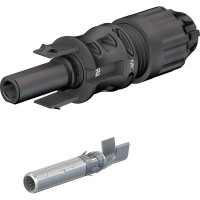
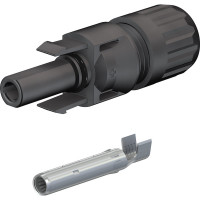
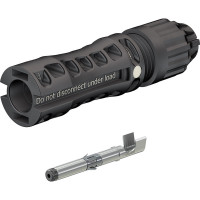
Specialist companies can find suitable solar connectors for standard-compliant PV installations in the EMC-direct range: Solar connectors. Further information on common causes of damage to photovoltaic systems can be found in the free EMC-direct white paper for download.
Free white paper on the safe operation of photovoltaic systems
EMC-direct experts have produced the white paper "Knowing and avoiding common causes of damage to photovoltaic systems" to raise awareness of the highest quality standards.
Source & further information
First published: 24.09.2025, guest article by Thaddäus Nagy on www.photovoltaik.eu