PV system cabling: Ensure performance through correct cabling
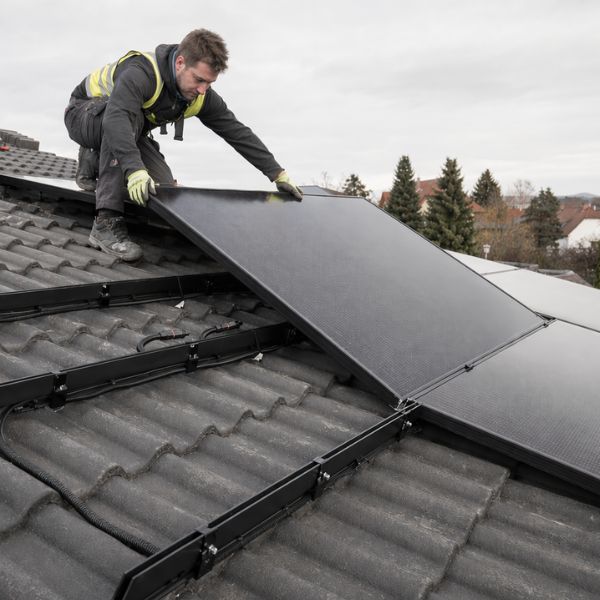
The correct cabling of a PV system is crucial for the safety, efficiency and service life of your photovoltaic system. From choosing the right cable cross-section to connecting the modules - every step has an impact on performance. Find out below how to wire your PV modules safely and professionally and avoid typical mistakes.
The basics of PV system cabling
Before you start installing your PV modules, it is important to understand the basic cabling components and standards. Correct planning reduces subsequent costs and increases the efficiency of your solar system.
Important cabling components
The cabling of a PV system comprises several essential parts:
- PV modules: Generate direct current (DC) from sunlight.
- Solar cables: Special cables for high UV and temperature resistance.
- Inverter: Converts direct current into alternating current (AC) for the power grid.
- Feed-in point: Connection to the domestic grid or electricity supplier.
- Cable ducts & installation pipes: Protect cables from the weather, mechanical stress and animal bites.
Protective devices for safe PV systems
In addition to correct cabling, protective components are essential for the safe operation of your photovoltaic system:
- DC disconnectors (load-break switches): Enables voltage-free switching of the DC side between modules and inverter - essential for maintenance work and in the event of fire. Mandatory according to DIN VDE 0100-712.
- Overvoltage protection type 1 + type 2: Protects the system from lightning strikes and overvoltages from the grid. Type 1 is installed on the house connection, type 2 on the inverter (in accordance with DIN VDE 0100-443 and 0100-534).
- Circuit breaker (AC side): Protects the AC side between the inverter and the feed-in point against overload and short circuit.
- RCD: Protects against dangerous residual currents - particularly important for PV systems with contact to earthed components.
- Cable protection with cable glands & conduits: EMC-direct offers UV-resistant cable glands (M16-M32, IP68) and cable protection conduits to protect against mechanical damage, weather and rodents.
DC vs. AC side
| Characteristic | Direct current side (DC) | Alternating current side (AC) |
|---|---|---|
| Range | PV modules to inverter | Inverter to feed-in point |
| Cable type | Special solar cable (UV & weather resistant) | Standard NYM cables or underground cables |
| Material | Mostly finely stranded copper cables, tinned | Copper or aluminum conductors |
| Voltage | Typically 600-1,000 V DC (residential buildings) | Low voltage (230V / 400V AC) |
| Standards | DIN VDE 0100-520 & DIN VDE 0100-712 | DIN VDE 0100 Part 410 & 540 |
Standards & guidelines
Clear safety and quality standards apply to PV system cabling:
- DIN VDE 0100-520: Electrical installations of PV systems, protection against electric shocks.
- DIN VDE 0100-540: Requirements for cables, lines and protective measures for direct current.
- Earthing obligation: Protection against overvoltages and electric shocks.
- Protective measures: Cables must be UV-resistant, protected against animal bites and correctly laid.
Tip: Proper earthing and the use of tested solar cables reduce the risk of performance losses and increase the service life of your photovoltaic system.
PV system cabling - planning the cable routes
Careful planning of the cable routes is crucial in order to minimize power losses, ensure safety and optimally connect the modules to the inverter.
Cable routes & laying
- Cables should have the shortest possible routes from the module to the inverter.
- Avoid sharp-edged points and external influences such as heat or moisture.
- Use cable ducts or installation pipes from EMC-direct to protect the cables mechanically.
Checklist for safe cable routing:
- No unnecessary bends or twists.
- Lay cables so that water can run off.
- Protect against rodents and mechanical damage.
Cable length & cross-section
Selecting the right cable length and cross-section is crucial to avoid power losses. Longer cables require larger cross-sections.
| Amperage (A) | Cable length up to 10 m | Cable length up to 20 m | Note |
|---|---|---|---|
| 8 A | 2.5 mm² | 4 mm² | For small strings (4-8 modules) |
| 16 A | 4 mm² | 6 mm² | For medium strings (8-12 modules) |
| 25 A | 6 mm² | 10 mm² | For large strings (12+ modules) |
Tip: Shorter cable runs reduce power losses, increase efficiency and reduce material costs.
Optimal arrangement of the PV modules
- Series connection: Increases voltage, but voltage failure possible in the event of a fault.
- Parallel connection: Increases current, reduces the risk of failure of individual modules.
- Plan strings correctly: Same modules in series, same strings in parallel to achieve maximum output.
Step-by-step guide to PV system cabling
Correct PV system cabling is crucial to ensure the safety, efficiency and service life of your photovoltaic system. Proceed as follows:
- Planning the cable routes: Plan the cable routes before installation. Make sure that DC and AC cables run separately.
- Selecting the correct cable cross-section: Calculate the appropriate cross-section based on the current and cable length.
- Mounting the solar modules: Attach the modules securely to the substructure.
- Connecting the PV modules (strings): Connect the modules and pay meticulous attention to the polarity.
- Earthing & protective measures: All metal parts and cable routes must be properly earthed.
- Connection to the inverter: Route the cables to the inverter and check all safety distances.
- Testing & commissioning: Measure voltages before switching on for the first time.
Fault prevention during cabling
| Fault | Risk | Solution EMC-direct |
|---|---|---|
| Incorrect polarity of the modules | Short circuit, loss of power | Marking and check before connection |
| Cable too thin | Voltage loss, overheating | Select suitable cross-section |
| Cable too long | Power loss, unclear | Calculate optimum cable lengths |
| Insufficient earthing | Electric shock, insurance problems | Have a specialist company check the earthing |
| Improper installation | Loss of performance | Installation according to the manufacturer's instructions |
Tip: Document every step of the wiring and keep photos or plans of the cable routes. This will make subsequent maintenance and troubleshooting easier.
Conclusion: Fault-free PV system cabling for maximum performance
Proper cabling of PV systems is the basis for smooth operation. Incorrect cable cross-sections, excessively long cable runs or improper earthing lead to power losses, safety risks and increased maintenance costs.
Do you still have questions about PV system cabling?
Which cable types are suitable for cabling photovoltaic systems?
Specially insulated solar cables that are UV and weather-resistant are used for PV system cabling. Copper conductors are common as they offer low line losses.
How do I choose the right cable cross-section for my PV system?
The cross-section depends on the current, the length of the paths and the permissible power loss. The calculation should be carried out in accordance with DIN VDE 0100-520.
Why is earthing necessary when cabling PV systems?
Earthing protects people from electric shocks and the system from overvoltage damage.
What is the maximum cable length in a PV system?
There is no fixed limit, but the voltage drop on the DC side should ideally be limited to between 1-3 %.
Managing Director of EMC-direct
Thaddäus Nagy is Managing Director of EMC-direct and is responsible for the strategic direction and further development of the company in the field of electrical connection technology and cable management.

Free white paper on the safe operation of systems
In order to raise awareness of the high quality requirements for the assembly and electrical installation of photovoltaic systems, experts have produced the white paper "Knowing - and avoiding - common causes of damage to photovoltaic systems" on behalf of EMC-direct.
Source & further information: www.photovoltaik.eu