- 1. What are bifacial modules?
- 2. Why classic fasteners are reaching their limits
- 3. Edge clips vs. wire clips
- 4. Cable routing for landscape systems
- 5. Avoiding errors during cabling
- 6. The challenge: frame edges less than 5 mm
- 7. S-shaped wire clips as the standard solution
- 8. Frequently asked questions about clamping
Clamping bifacial modules correctly: Optimal installation for bifacial photovoltaic modules
Bifacial modules are one of the increasingly widespread technologies in modern solar installations in Germany and Europe. However, due to their ability to convert sunlight into electricity on both the front and rear sides, the technical requirements for cable routing and installation on the back of the module are also increasing significantly.
What are bifacial modules?
Bifacial modules are photovoltaic modules that convert sunlight into electrical energy on both the front and rear sides. In comparison to classic monofacial modules, they can achieve a higher yield depending on the site conditions.
Bifacial modules are increasingly being used in ground-mounted systems and Agri-PV projects, as they offer higher efficiency per square meter due to the backside light yield. However, correct installation is crucial to avoid damage to the module frame or loss of power.
Why classic cable fasteners are reaching their limits in modern PV systems
With the further development of modern photovoltaic modules - especially bifacial glass-glass modules - the requirements for cable management have also changed significantly. However, many conventional cable fixings were developed for older generations of modules with wide aluminum frames and single-sided energy generation.
Modern bifacial modules place new demands on cable routing:
- Narrow frame edges: On the short module side, the usable edge is often <5mm - too little for classic edge clips.
- Narrow module spacing: In landscape installations, surface-mounted fastenings collide with neighboring rows of modules.
- Box profiles: Closed hollow chamber profiles offer hardly any points of attack for edge clips.
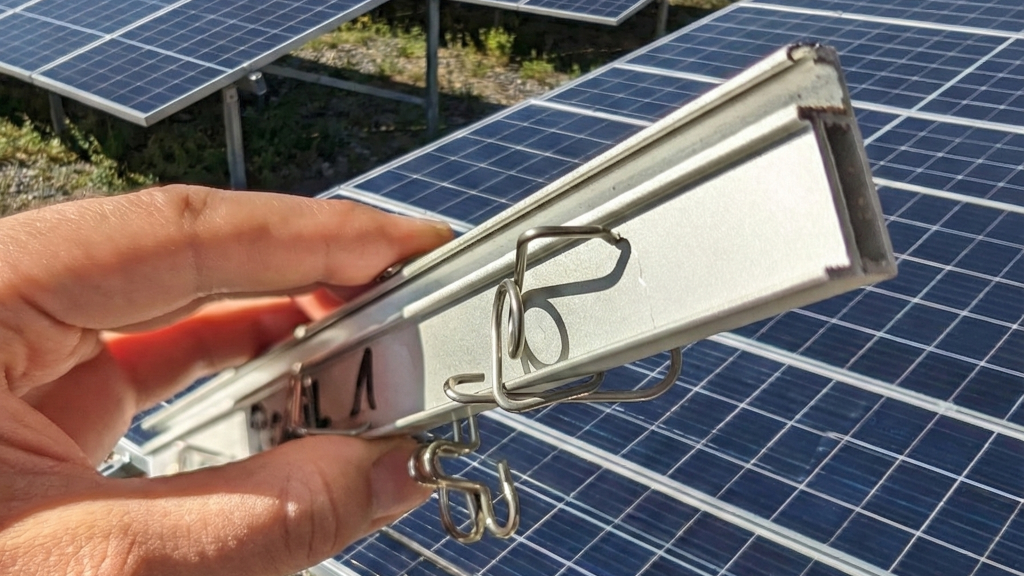
Wire clips solve these problems thanks to their flexible spring steel construction.
Edge clips vs. wire clips
In modern photovoltaic installations, the choice of the right cable fastening system is crucial. While classic edge clips were the standard for a long time, wire clips are now becoming increasingly popular for professional PV installations in Germany .
| Feature | Edge clips | Wire clips (spring steel / S-shape) |
| Fastening principle | Mechanical fixing to the edge of the frame | Tension-based fixing via spring force |
| Suitable for narrow frames (<5 mm) | Unsuitable | Optimal |
| Suitable for long module side (>15 mm) | Well suited | Suitable |
| Contact surface on module | Large-area edge support required | Minimal or low-point contact surfaces |
| Mechanical load | May damage anodized layer | No damage to the frame edge |
| Use for landscape layouts | Problematic with narrow module spacing | Very well suited for narrow module spacing |
Cable routing for landscape PV systems and narrow module spacing
In Germany, PV systems are increasingly being planned with high area efficiency. Landscape installations on commercial roofs or ground-mounted systems in particular require very narrow module spacing.
This places high demands on cable management:
- little space between module rows
- increased requirements for clean string routing
- Avoidance of shading on the back of the module
Wire clips enable direct, space-saving cable routing along the back of the module without additional loss of installation space.
Error prevention during cabling
| Fault | Risk | Solution EMC-direct |
|---|---|---|
| Incorrect polarity of the modules | Short circuit, loss of power | Marking and check before connection |
| Cable too thin | Voltage loss, overheating | Select suitable cross-section |
| Cable too long | Power loss, unclear | Calculate optimum cable lengths |
| Insufficient earthing | Electric shock, insurance problems | Have a specialist company check the earthing |
| Improper installation | Loss of performance | Installation according to the manufacturer's instructions |
The challenge: frame edges under 5 mm
At the short module side of modern bifacial modules, the classic mounting edge disappears. With a typical frame height of 30 mm, the usable edge is often less than 5 mm - classic edge clips no longer engage securely and can damage the anodized layer of the frame.
This leads to typical installation problems:
- classic cable clips do not have a sufficient contact surface
- Edge clips lose mechanical hold
- increased risk of material stress on the module frame
- restricted cable routing with tight module connections
This problem is exacerbated in particular in narrow PV layouts with landscape installation.
S-shaped wire clips as a standard solution for modern PV systems
S-shaped wire clips made of spring steel are a particularly proven system in professional photovoltaic installations.
These have been specially developed for the requirements of modern bifacial modules with narrow frame profiles :
- flexible S-geometry for tension-free cable retention
- quick or low-tool installation
- no mechanical stress on the sensitive module edges
Conclusion: Precise cable routing is crucial for efficiency and operational safety
The professional cable routing of bifacial photovoltaic modules is an important factor for the long-term efficiency and operational reliability of modern PV systems. Even minor planning or installation errors can lead to unfavorable cable routing, mechanical stress or indirect yield losses due to shading .
Modern solutions such as wire clips made of spring steel enable material-friendly, space-saving and permanently stable cable routing, even in narrow module arrays and landscape installations.
Anyone who consistently implements these requirements and takes them into account as early as the planning phase creates the basis for an efficient, low-maintenance and durable photovoltaic system with high yield stability.
Frequently asked questions about clamping bifacial modules
Can wire clips be retrofitted in existing PV systems ?
Yes, wire clips can be easily retrofitted in many cases, as long as there is access to the back of the module. Existing cable fastenings can be replaced, especially during maintenance work or string optimization. It is important to redesign the cable routing to avoid tension or unfavorable bending radii.
Are there standards or specifications for cable routing in PV systems?
Yes, cable routing in photovoltaic systems is subject to various technical requirements. The central standard is DIN VDE 0100-712, which specifies requirements for mechanical protection, cable routing and electrical safety in photovoltaic systems. For PV cables themselves, EN 50618 applies, which defines requirements for weather and UV resistance and minimum bending radii during installation, among other things. In addition, the module manufacturer's installation instructions must be observed, as they define specific requirements for permissible fixing points and cable routing.
How do extreme temperatures affect the cable routing ?
Extreme temperatures lead to expansion and contraction of cables and module frames. Without flexible fastening, this can lead to mechanical stresses. Wire clips counteract these movements as they work elastically and do not fix cables rigidly. The reduces material stress and prevents long-term damage to cables or plug connections.
Can wire clips be used with all module manufacturers ?
In principle, wire clips can be used universally, but the specific frame geometries and installation instructions of the module manufacturers must be observed. Some manufacturers provide exact specifications for cable routing and permissible fixing points. It is important that the clips do not exert any mechanical stress on critical glass or frame areas and are compatible with the substructure .
Managing Director of EMC-direct
Thaddäus Nagy is Managing Director of EMC-direct and is responsible for the strategic direction and further development of the company in the field of electrical connection technology and cable management. With many years of experience in electrical engineering and a deep understanding of industrial applications, he is intensively involved with the requirements of modern energy and photovoltaic systems.

Free white paper on the safe operation of systems
In order to raise awareness of the high quality requirements for the assembly and electrical installation of photovoltaic systems at , experts have produced the white paper "Knowing - and avoiding - common causes of damage to photovoltaic systems" on behalf of EMC-direct.
Source & further information: www.photovoltaik.eu